This Is Not Rape
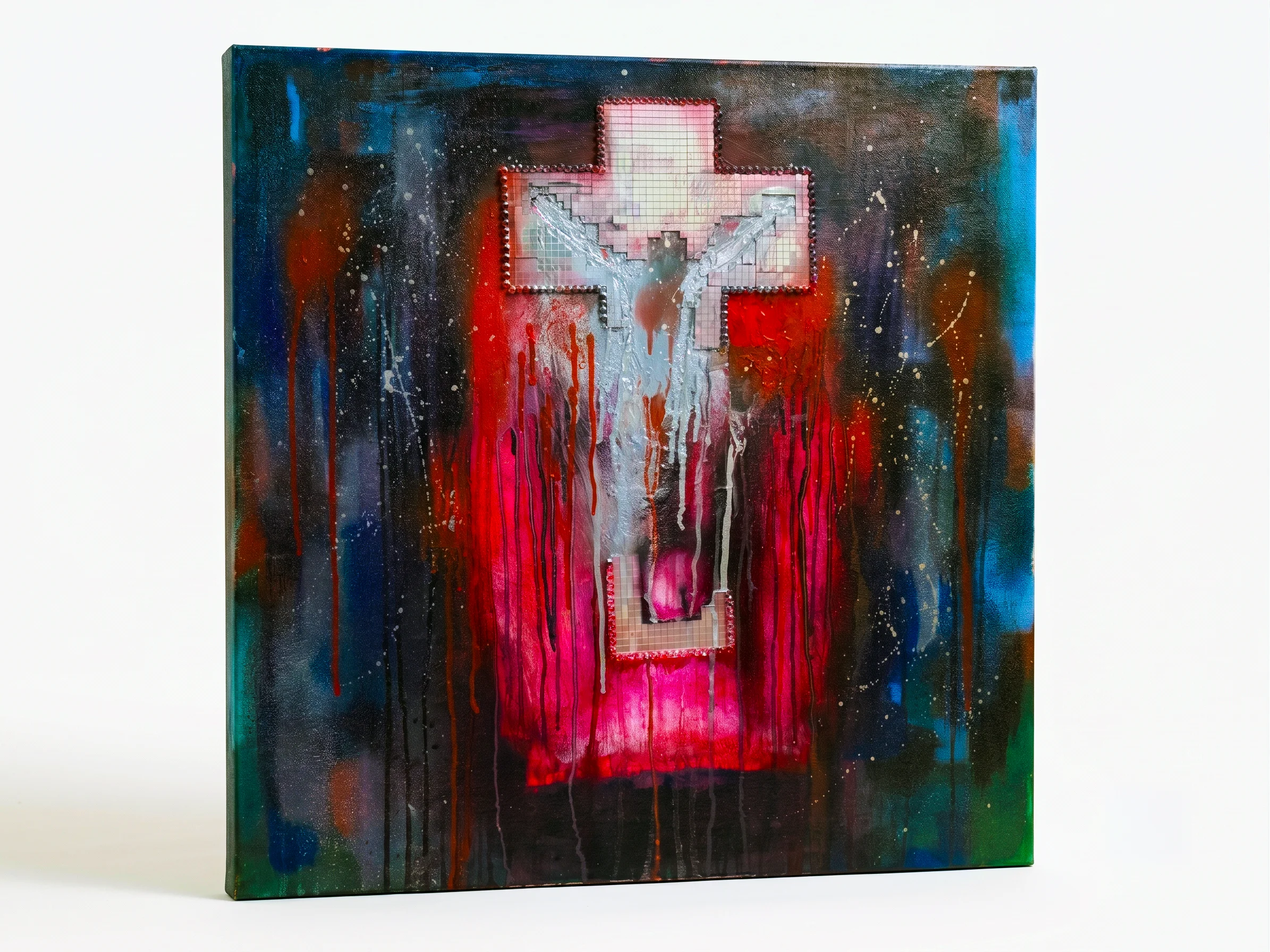
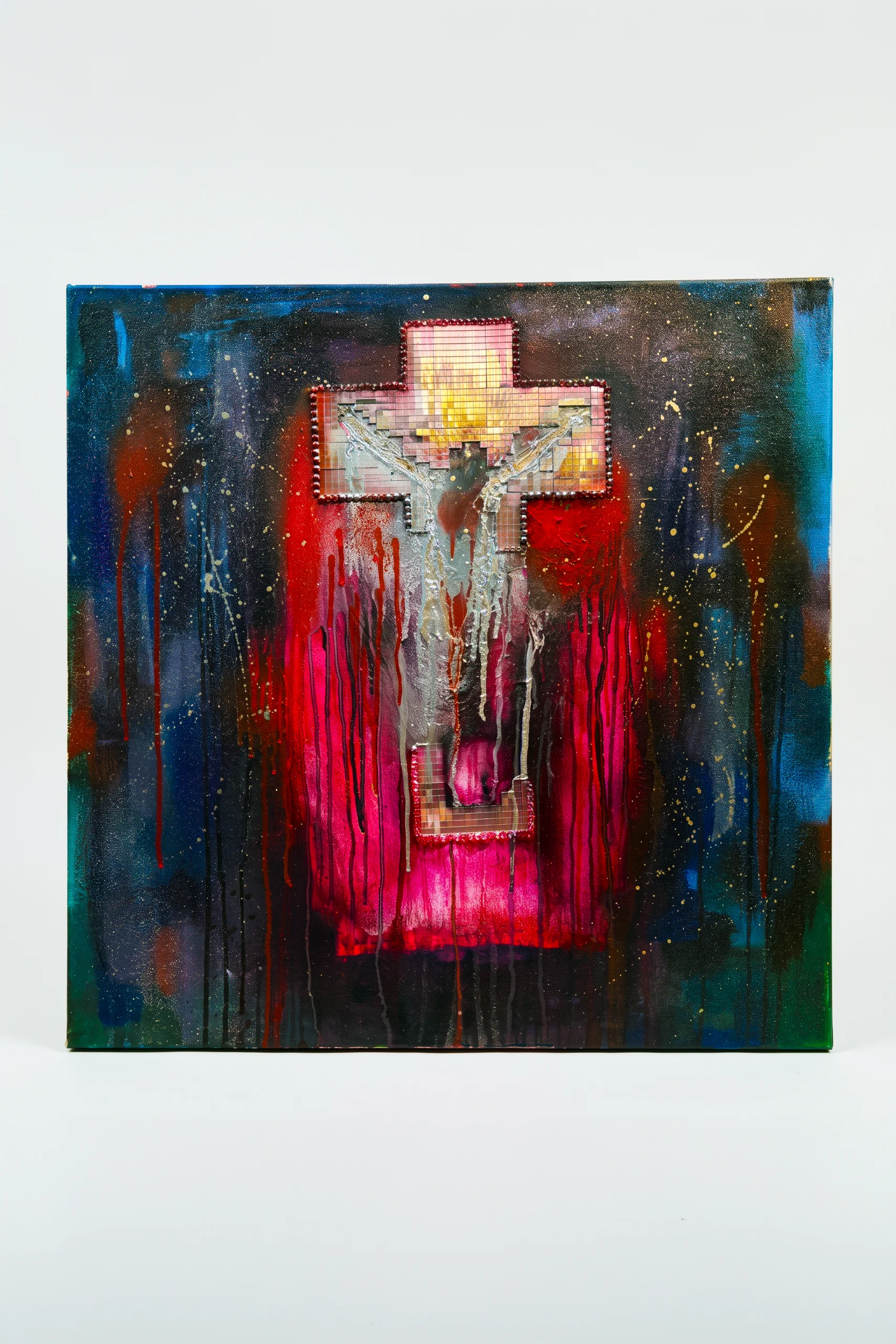
An ornate cruciform structure exposes and absorbs a body at once, turning the icon of suffering into a device that controls how harm is seen, named, and understood.
Curatorial Summary
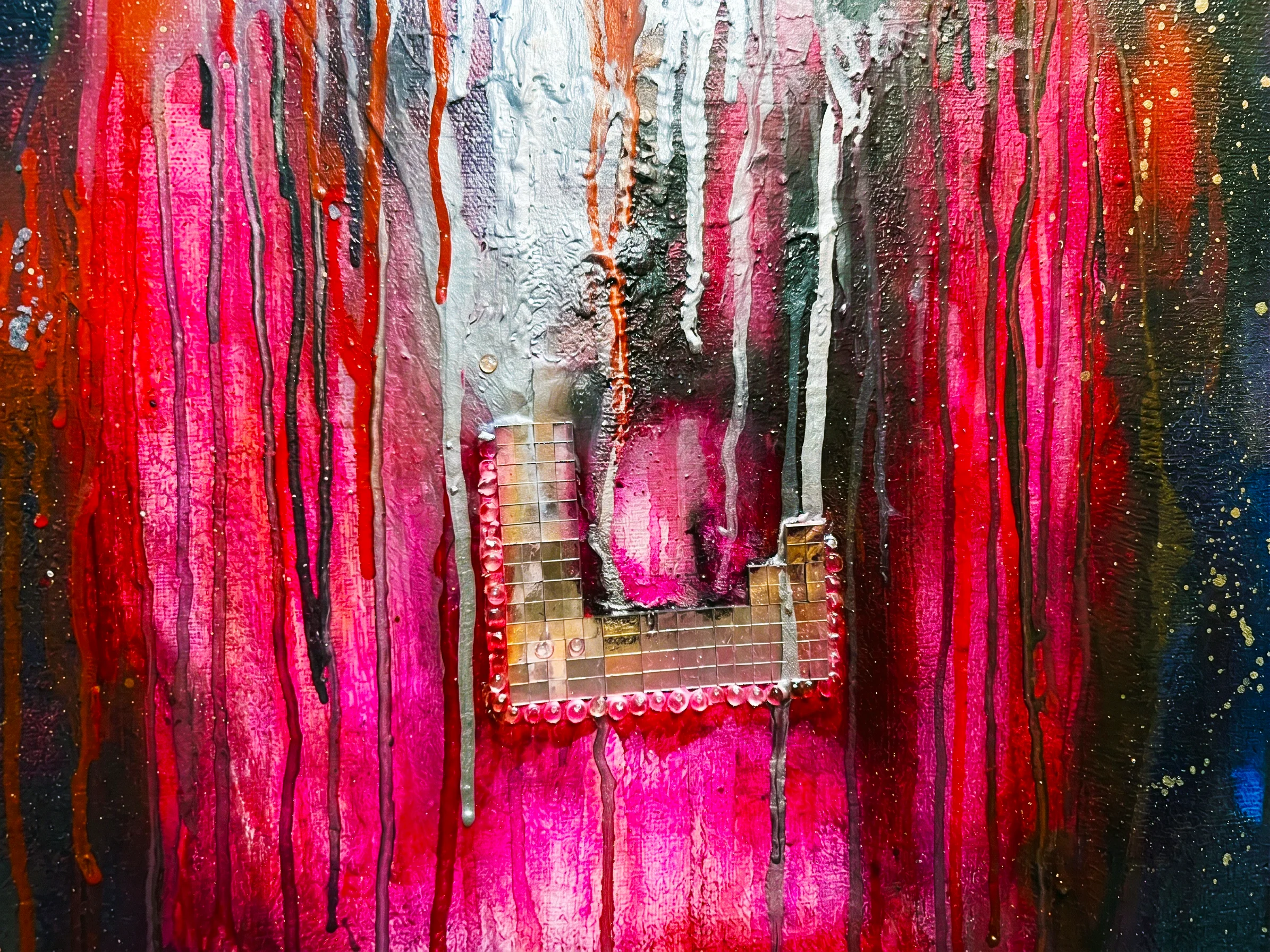
At the centre of “This Is Not Rape,” a cruciform structure assembled from reflective tiles, crystals, printed fragments, transparent layers, and flowing silver material fixes an elongated body within a field of red, blue, and black. Its jewel-like border evokes a reliquary, while the unstable surface shifts between religious icon, screen, wound, and phallic form. Light is caught and scattered across the cross, drawing attention toward a figure that simultaneously dissolves into reflections, drips, and accumulated material. The red rectangular field behind it functions as an altar, inner frame, and exposed wound, intensifying the tension between display and obstruction. Rather than presenting a single identifiable event, the work examines how images organize suffering and impose meaning upon it. The title introduces the syntax of denial, asking how language can contest the recognition of harm even when its traces remain embedded in the body and the image.
artist
statement
In “This Is Not Rape,” I work with signs that have shaped how queer and trans bodies are classified, displayed, and disciplined: the cross, the phallic form, and the rectangular field of the image. Their shared vertical and framing structures organize the composition, establish its centre, and determine where the body can appear. I enter this inherited visual language without claiming full control over it. The signs remain charged with the histories and institutions that gave them authority, even as I distort and rearrange their functions.
The iconography of the crucifixion provides a structure for examining how suffering becomes a public image. The cross holds the body in place, exposes it to collective scrutiny, and assigns meaning to its pain. In my work, it also becomes a scaffold for the gaze: a framework through which religious, medical, and legal systems impose fixed narratives of gender and embodiment. I paint the cross as distorted, bleeding, pixelated, and illuminated. Its form moves between devotional icon, digital artefact, wound, and phallic sign, resisting a single interpretation while continuing to divide and stabilize the field of vision.
Acrylic paint, glitter, laser print on paper, transparent plastic, and crystals create a surface that attracts the gaze while interfering with its access to the body. The shimmer does not soften the violence contained in the composition. It participates in the ways violence can be aestheticized and presented through the languages of care, protection, morality, or salvation. Paint and printed image remain partially visible behind reflective and synthetic materials, making the work oscillate between exposure and obstruction. The body appears within this unstable surface without becoming fully available to the narratives imposed on it.
The title quotes a familiar syntax of denial surrounding sexual violence: a statement that attempts to control an event by controlling its name. It addresses the political force of language that minimizes harm, contests testimony, and decides which experiences can be recognized as violence. The work does not use rape as a metaphor for representation. Instead, it examines how images and words can participate in structures of denial, concealment, and misrecognition. The reference to Magritte’s “Ceci n’est pas une pipe” marks the distance between an event, its representation, and the sentence that claims authority over both. In this context, however, the declaration carries consequences beyond a semiotic game: naming or refusing to name violence shapes how it can be understood, remembered, and contested.
The queer body remains attached to the cross even as it modifies the symbol. This relation offers no simple reversal in which domination disappears and the body takes complete possession of the image. The cross continues to organize the composition, while the body contaminates its authority through colour, ornament, distortion, and excessive visibility. I am interested in this unresolved contact: using a sign that can still wound, allowing it to carry another body and another account of what has happened.
The work asks whether a personal relation to the sacred can emerge from within signs already implicated in violence. Reworking them does not erase their history. It creates friction between inherited authority and embodied experience, leaving the cross suspended between discipline, exposure, desire, and a sacredness that remains open to revision.
exhibition dates