Queer Mother Fucking the Cistem
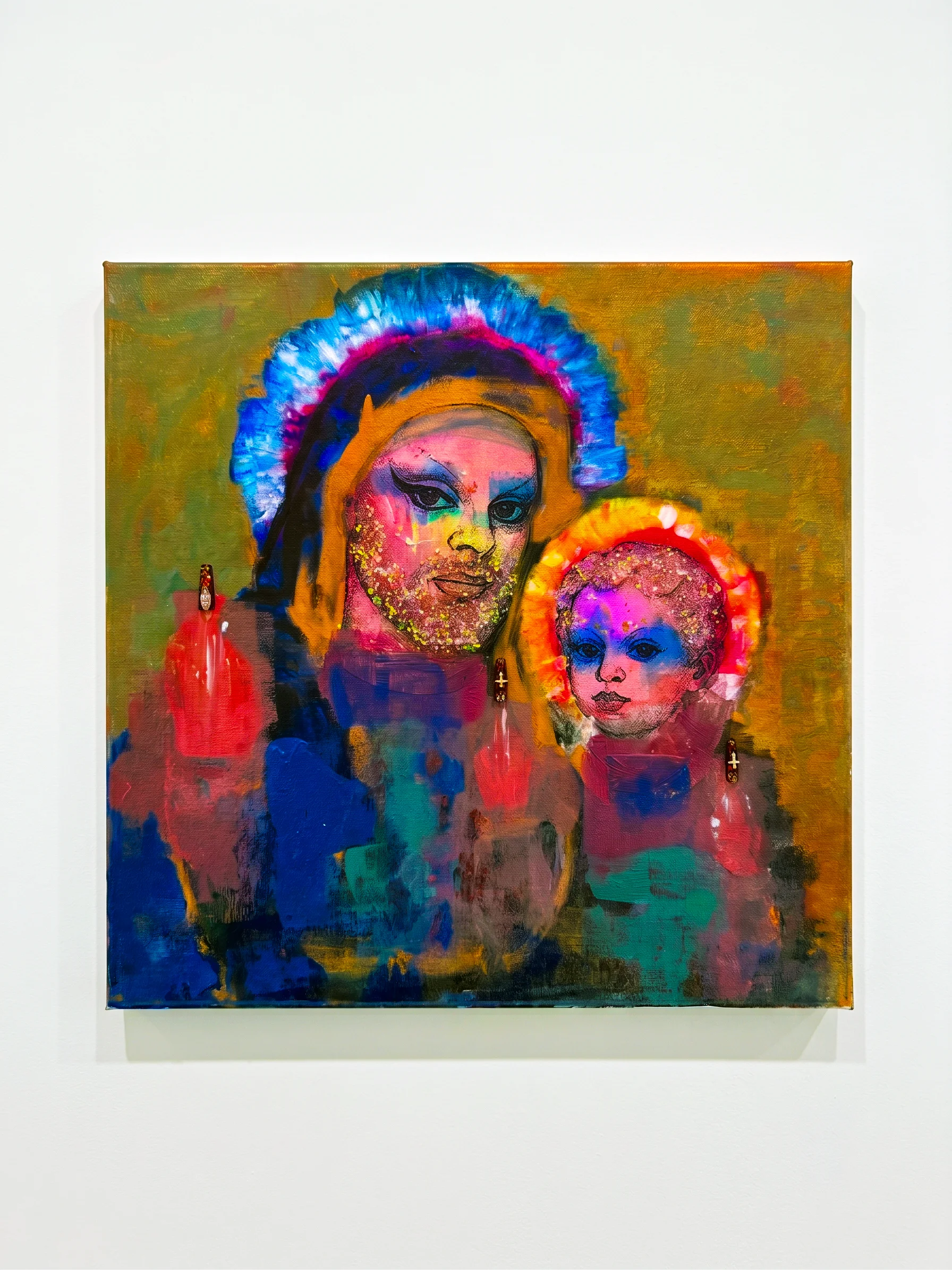
A drag-transformed Madonna and Child retain the authority of a devotional icon while shifting its faces, ornament, and gendered codes toward a more unstable form of sacred representation.
Curatorial Summary
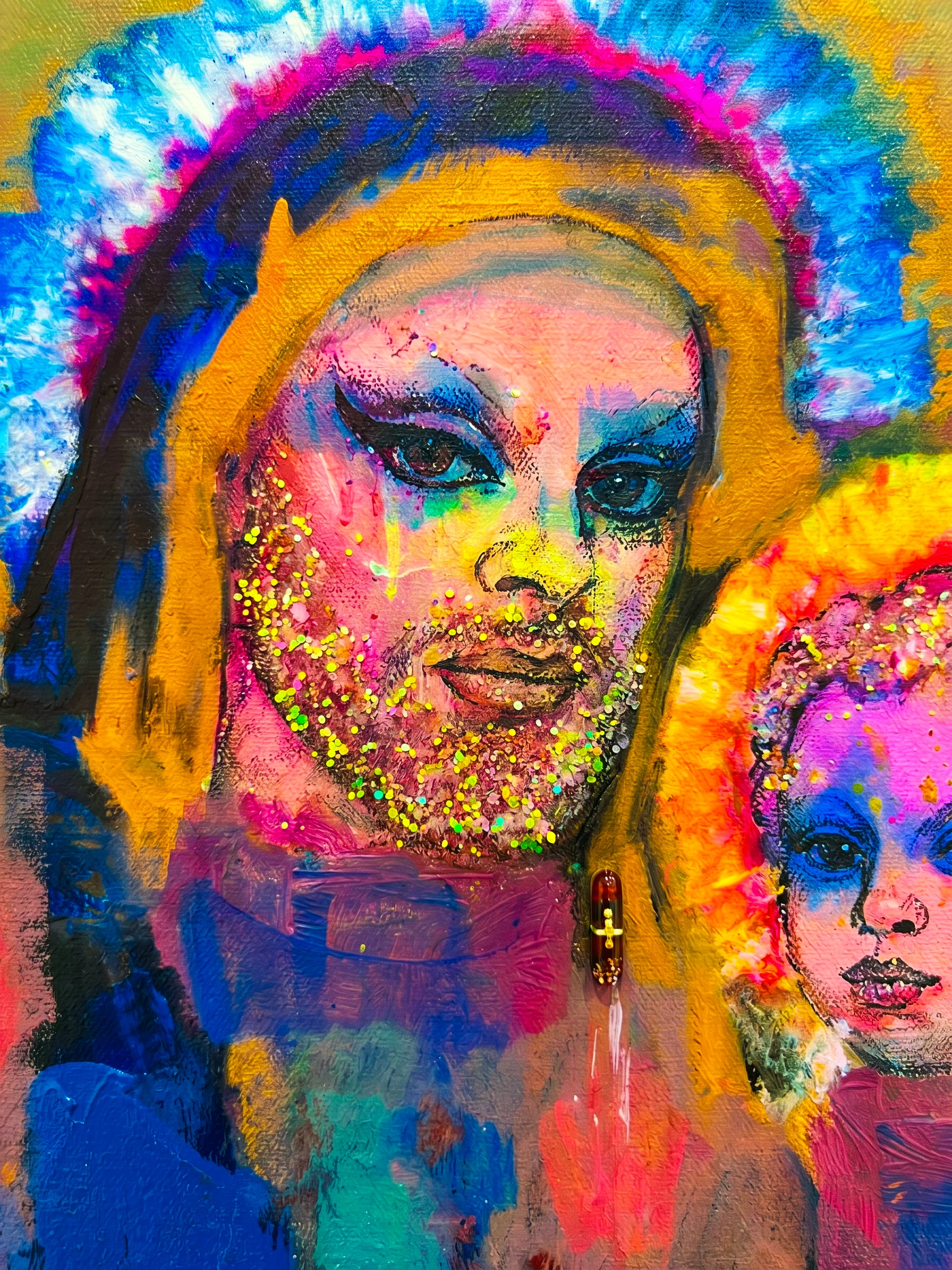
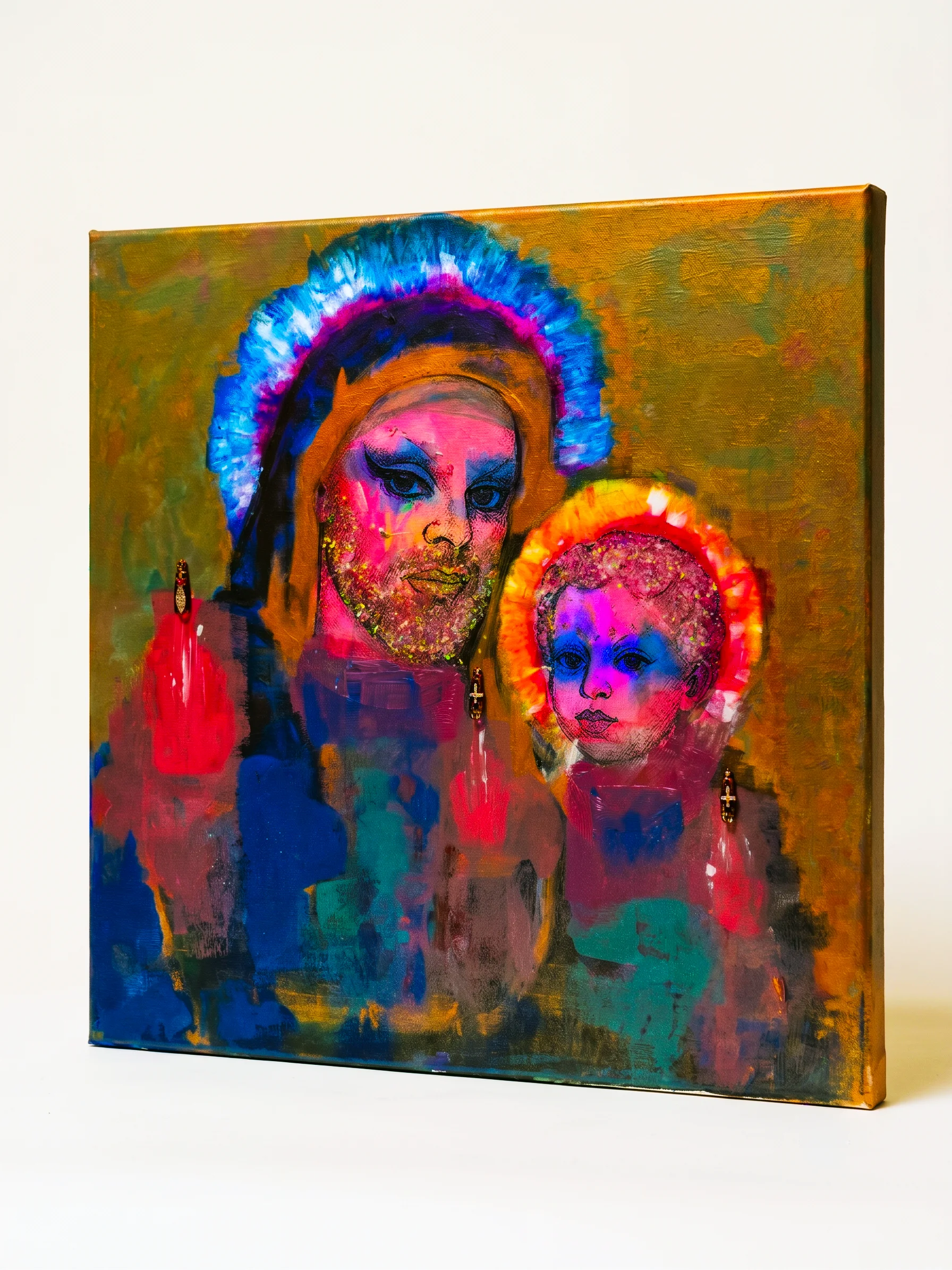
Set against a gold-olive ground, the painting preserves the frontal composition and visual gravity of the Madonna and Child while rebuilding both figures through saturated colour, theatrical makeup, glitter, and small synthetic applications that evoke jewellery, votive objects, and plastic nail tips. Their faces remain sharply articulated and meet the viewer directly, while the lower parts of their bodies dissolve into loose, overlapping layers of paint. This contrast between hieratic presence and unstable materiality moves the image beyond a simple parody of Catholic iconography. Drag styling and gender ambiguity enter the structure of the devotional portrait without erasing its intimacy or authority, allowing “Queer Mother Fucking the Cistem” to test how an inherited icon changes when its sacred figures are constructed through ornament, performance, and trans-femme visual language.
artist
statement
The Black Madonna of Częstochowa belongs to the visual memory of my upbringing. Her image circulated through classrooms, textbooks, churches, public ceremonies, and political speech, binding religious devotion to national identity and prescribed forms of gender. In “Queer Mother Fucking the Cistem,” I return to an icon already imprinted in my body and treat it as material: something that can be handled, altered, and made to carry experiences that Catholic institutions have pushed outside the sacred.
The work begins with the familiar composition of the Madonna and Child and subjects it to a material transition. Acrylic paint meets glitter, holographic foil, print, and plastic nail tips. Their synthetic surfaces, decorative excess, and associations with drag, club culture, and low-prestige ornament disturb the authority traditionally assigned to painting and religious representation. The holographic foil divides light across the figures, preventing the image from settling into a single, stable form. Its appearance changes with the movement of the viewer, the angle of vision, and the conditions of the room.
UV-reactive paint introduces another layer that emerges under ultraviolet light. Visibility becomes conditional: parts of the image appear only when the conventional exhibition light recedes and another environment is created. This shifting surface allows sanctity to exist as unstable and embodied, produced through movement, proximity, darkness, and access rather than fixed permanently within the icon.
The work belongs to the “Iconoclasm” series, which examines how inherited symbols can be loosened from the functions assigned to them. Here, the Black Madonna undergoes a visual and gendered transformation. Rainbow halos, camp materials, and raised middle fingers enter the hieratic composition without erasing its recognizability. The gesture carries anger, humour, profanation, pleasure, and refusal at once. It turns the devotional image toward the history of protest surrounding the “Rainbow Madonna,” including the legal and media attempts to criminalize its public use as an act of religious offence.
Glitter and plastic operate through their decorative force. Their brightness interrupts solemnity while preserving the urgency of the gesture. They produce a dirty radiance in which holiness no longer depends on purity, obedience, or institutional recognition. The image asks what forms of sacredness can emerge through bodies marked as improper, vulgar, excessive, or illegible—and what happens when those bodies transform a symbol without waiting for permission.
“Queer Mother Fucking the Cistem” does not replace Catholic orthodoxy with a stable definition of queer sanctity. It holds profanation and devotion within the same unstable image. The Madonna remains an inherited icon, a contested surface, and a body in protest. The work becomes a form of prayer shaped through alteration, ultraviolet light, ornament, and an uncompromising gesture directed at the order that once claimed exclusive authority over the sacred.
exhibition dates